Everything you need to cross the Hong Kong–Zhuhai–Macau Bridge with confidence — travel times, the apps to download, and the mistakes to avoid.
Honestly, there are so many options now to get to Zhuhai and then on to Doumen from Hong Kong, mainly via the Zhuhai–Hong Kong Bridge – properly known as the Hong Kong–Zhuhai–Macau Bridge (HZMB). This guide walks you through every route — bridge, bus, car, and ferry — with practical detail.
This post is mainly about the journey from Hong Kong to Zhuhai, but I mention Doumen throughout because that’s where I’m usually heading. For more on Doumen itself, see my companion guide here. (https://www.ivantheodoulou.com/blog/doumen-zhuhai-weekend-guide)
The Bridge Itself
The 55-km HZMB is the longest bridge-and-tunnel sea crossing in the world and operates 24 hours a day. By car, the journey only takes 40 minutes, and the bus takes about an hour. It is well worth doing this at least once just to be able to marvel at the engineering feat of travelling across a bridge in the middle of the sea.
One thing to note is that the HZMB is not an all-weather road and may close if the weather is bad. When I’ve gone across in very heavy rain, there were speed reductions due to poor visibility and high winds, making travel time longer. It’s got to get really bad, like Typhoon bad, for the bridge to cease operations temporarily.
Getting to Doumen by Car or Taxi
If you drive and have the HZMB permit, Doumen is about half an hour from the Zhuhai immigration building. There are also now taxi services across the bridge which often require booking in advance. I caught a private (shared) taxi from Mong Kok to Zhuhai Airport once for HK$260 one way and then took a ride-hailing cab from there to Doumen.
One thing to be aware of is that you should check the vehicle you hire has the license to carry passengers across the HZMB.
Crossing the HZMB by Bus
If you want to take the bus over the bridge, there are services from Kowloon and it's all quick and organised. Usually, if I'm going by bus to Zhuhai, I go to the HZMB Passenger Clearance Building on Lantau because it’s convenient for me.

I’ve also taken a bus to the Hong Kong International Airport from places like Quarry Bay and Hang Hau because after stopping at Terminal 1, it stops at the PCB. Perfect if you aren’t in a hurry.
Once at the PCB, you clear immigration and customs, then buy a ticket from a machine – there are only two destination options: Macao and Zhuhai – for HK$65 (different rates for age and times) using Octopus or Alipay HK.
There is also a ticket counter. Buses run every 5–15 minutes and it’s extremely well organised and efficient, with staff on hand to help. I can’t rate this place highly enough when it comes to efficiency.
Then it's a short walk with your luggage to the bus along a clearly marked path. It will either be a single-deck coach or a double-deck bus. If it’s a coach, your bags go in the hold. If it’s a bus, suitcases are stacked in the rear seat area.
It’s free seating, there isn’t much legroom, and there are announcements about putting on the seatbelt and the staff check. Then off you go on the big bridge adventure!
Note the Passenger Clearance Building has limited places to buy food and drinks. There’s a 7-11 selling the usual sandwiches, chips, chewing gum and a variety of soft drinks. There is a place to by duty free near the ticket machines. There’s also a currency exchange.
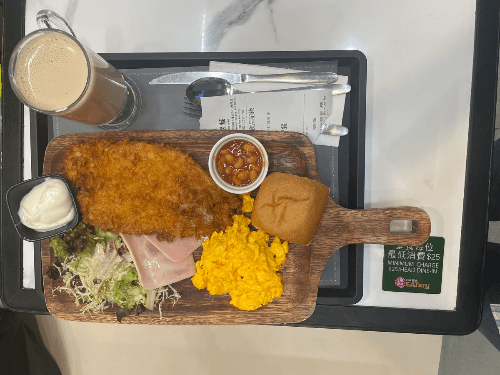
The arrivals hall downstairs has a rather wonderful Tsui Wah Eatery serving hot food. I got a fish breakfast here once for HK$69 as below. Probably the best value breakfast anywhere in Hong Kong!
Ferries from Hong Kong to Zhuhai
[I haven’t taken a ferry to China for a very long time – I think at least 12 years when I went from TST to Shunde. So the following information is from my research in case it’s of help.]
As an alternative, and if you'd rather travel by sea, there's a Zhuhai to Hong Kong ferry service too, arriving at Zhuhai Jiuzhou Port. It's a scenic alternative to the bridge and easy enough to book online.
Two possible options are:
- Hong Kong Ferry (departing Sheung Wan): hongkongferrybooking.com
- Klook – Zhuhai to Hong Kong ferry tickets: klook.com
Whether you take the Zhuhai ferry from Hong Kong or the bridge really comes down to where you're starting from and how much time you have. The port has free Wi-Fi inside the building, but my tip is to sort out a roaming package before you travel rather than relying on it.
A friend of mine learnt this the hard way. He arrived on the last ferry with no roaming, found taxis were sparse, and had to wander out into the street to hunt one down — at which point the Wi-Fi dropped out and he was stranded with no signal. He called us and we got him a taxi.
Is the
Bridge to Macau or Zhuhai?
One thing to note: the Hong Kong to Macau bridge is the same as the Hong Kong to Zhuhai bridge.
After clearing the toll gates on the Macao and Zhuhai side, cars or buses will go to either the Macau or Zhuhai terminal building because it's an artificial island catering to both destinations. The big difference is the size of immigration. On the Macau side, it's the size of an aircraft hangar, whereas the Zhuhai–Macau Port side is considerably smaller.
But more cars pass through to Zhuhai so there are more car lanes, whereas Macau has far fewer. This is because cars from Hong Kong aren't allowed to drive into Macau after crossing the bridge but have to park at the terminal building (unless they have a permit to drive into the city). To drive in Zhuhai, on the other hand, you need a China driving licence (and China car insurance) because the HZMB is in China waters, hence the difference.
Something else to point out. On public holidays the queues to access either Macao or Zhuhai can be enormous. Plus, public holidays in China mean the tolls on highways are free for private vehicles so, again, check your departure times and edge towards the off-peak times if you can.
That was a long but necessary explanation!
Arriving at Zhuhai Port

Once you arrive at the Zhuhai port, de-bus and walk to immigration. I have a two-way permit so can just sail through the face-recognition scanners. For those that do not have this permit, there is an online arrivals form accessible via the QR code found in the arrivals building.
Fill that in, then head to the appropriate immigration desk for travel document checking, face and fingerprint scan, visa stamp and then through immigration in Zhuhai (please, please make sure you have a visa, or that your passport allows visa-free stays on arrival, and that you have mobile roaming or a SIM card for China BEFORE you travel).
After immigration it's another short walk to customs where all luggage and bags get x-rayed, then before you head to C2 in the underground car park for ride-hailing and taxi services, grab a photo opportunity at the below:

Having taken many photos and selfies, it's time to get that cab and high-tail it outta there!
Look for the green directional signs to C2 and C3 and there's also an English recorded voice telling people where to go. It's all very helpful.
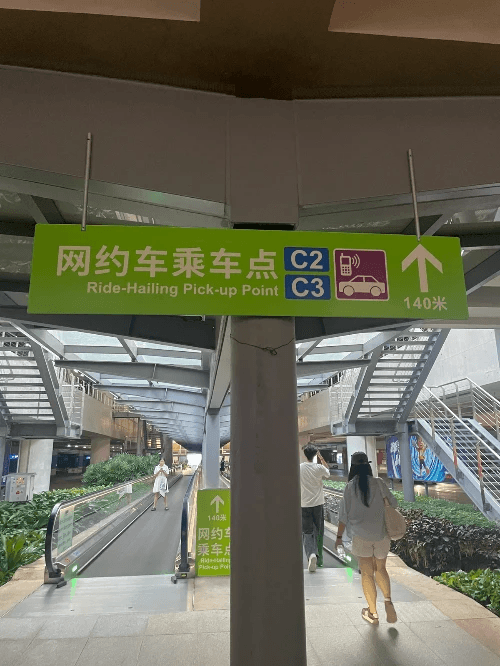

Once you have ordered a taxi, you need to look out for the number plate as the cars come in and it should say on the app receipt what the number plate is and which parking space it will stop (C1, C2 etc.).
Note the underground car park does not have ventilation or aircon, few fans and it can get pretty darn hot down there in the summer. There are barely any seats nearby. Once booked, taxis come quickly, so thankfully you don't need to spend too much time sweating.
Top 5 Apps You Need in China
Here's my priority app stack for travel in China:
- A payment app. This is essential. It’s mostly a cashless societyy. I use Alipay HK. You can still use cash because it’s legal tender.
- A map app. Amap is my preferred choice and works brilliantly for getting around. The international version has an English voice and offers suggestions on where to go, what to do.
- A taxi app. I use Alipay HK to book ride-hailing cabs, though Didi is also widely used. With these apps it’s possible to link your credit card.
- A translation app. You'll need it. Make it is non-Google.
- WeChat. I'd add this to your China apps stack purely because everyone in China is on it, and the in-chat translations (only tried English) are better than you'll find on Facebook or other social media platforms by far.
One thing to note is that customer service on these apps is generally superb – and it's usually AI, so you get a quick, helpful answer.
My tip is to download and set up before you enter China so you know everything is working.
A Reminder: Driving After Drinking in China
I thought it was worth adding a quick note about drink-driving laws in China, because they’re strict and the penalties are steep. And it’s not just cars: riding a motorcycle or even a non-motorised vehicle after drinking can also count as a violation under Chinese law.
In China, "driving after drinking" applies when your blood alcohol concentration (BAC) is between 20 and 79 mg per 100 ml. Put simply, if you drink one standard glass of wine — about 150 ml — you’re in the illegal driving / riding zone.
For a first offence at this lower level, you can expect your licence to be suspended for six months, a fine, and 12 points added to your record. A second offence sees things ramped up considerably with a fine, prison, and your licence revoked all on the table. If you cause a major accident that amounts to a criminal offence, you can be banned from driving in China for life, and more.
So, my advice is simple: don't drink and drive. Ever.
That's it. I hope you find this guide useful and you have a great time in Zhuhai.
I'm just going to indulge with another fine photo of the The Zhuhai Jinwan Civic Art Centre. It's in my top ten list of favourite buildings in China.

About Ivan Theodoulou
The founder of Eight PR, an international and independent PR agency in Hong Kong, Ivan first visited China in 1987 by train from Hong Kong to Guangzhou and has since travelled extensively on the mainland and in the Greater Bay Area (GBA). He passed his China driving test in March 2024.
Places visited in China (by car, plane, train, high speed train, ferry, coach, bus) include: Beijing, Beijou, Chengdu, Dali, Daya Bay, Dongguan, Ganzhou, Gaoming, Guangzhou, Hainan, Hailing Island, Heishan, Huizhou, Junan, Kunming, Lijang, Longjiang, Nanhai, Shanghai, Shanwei, Shenzhen, Shilin Yi, Shunde, Wuzhou, Xiamen, Xiqaio, Yingde, Yinghe, Zhuhai, and Zhaoqing.
If you liked this post, try these:
1. Discovering Hailing Island, China
https://www.ivantheodoulou.com/blog/hailing-island-china-driving
2. Engineering Feat: The Hong Kong-Zhuhai-Macao Bridge
https://www.ivantheodoulou.com/blog/gba-hkzmb-engineering-marvel
3. Unlocking China's Greater Bay Area: Hong Kong Residents To Embrace Self-Drive Holidays?
https://www.ivantheodoulou.com/blog/boom-waiting-to-happen